Monday, October 20, 2014

Low Gap, Appalachian Trail, & Lower Mt. Cammerer

New Miles Completed: 7.3
Total Miles Hiked: 15.5
17 October 2014

Autumn is the most magical time of year in the Smokies.  Any time of year in the Smokies is wonderful, but the combination of sunshine, cool temperatures, clear skies, and colorful leaves in autumn makes it unparalleled in its beauty.

The new trail miles for this hike were to be found on the Lower Mt. Cammerer trail, a 7.3 mile connector between Cosby and the Appalachian Trail in the northeastern corner of the park.  To make this trek more interesting, and to get to visit one of my favorite spots in the park, I decided to make a loop out of it.  I started at the Cosby campground, went up the Low Gap trail to the AT, across Mt. Cammerer on the AT, and then connected with the Lower Mt. Cammerer trail back to Cosby.

 Trailhead at the hiker parking lot

 Trail junction leading to either Lower Mt. Cammerer or Low Gap trail

 Real beginning of the Low Gap Trail at the edge of Cosby campground

There is a maze of trails around the Cosby campground - the Cosby nature trail, side trails leading to the Lower Mt. Cammerer trail, and to the Low Gap trail.  Luckily, most of the junctions have signs pointing hikers in the right direction.  The trail from the hiker parking area up to Low Gap is 2.9 miles long, and gains about 2000 feet in elevation.  Once you are above the campground, the trail becomes pretty relentlessly uphill.  I was alone, it was early and chilly, and I had fresh legs, so I managed this section in just over an hour, which is a pretty good pace for me.  As Cosby is on the north side of the ridge, this part of the hike was shaded, but as I got closer to the gap I could see the sun peeking through the trees.  Given all the rain we've had over the last few weeks, the bright sunshine was welcome!

 Trail junction with the Appalachian Trail at Low Gap


At Low Gap I turned left (northeast) on the Appalachian Trail, and headed up the flank of Mt. Cammerer.  The AT rises a few hundred feet, and then straddles the ridge for about a mile before it meets the side trail to the Mt. Cammerer fire tower.  This is my favorite kind of trail - high elevation, with great views off to either side, and the sun and the wind in my face.

 View of the Mt. Cammerer ridgeline

 The AT along the crest of Mt. Cammerer.

The side trail to the Mt. Cammerer fire tower is 0.6 miles long, and hugs the northern flank of the ridgeline.  The fire tower itself is, I think, one of the most majestic structures in the park - in part at least because of its setting, jutting out on the very end of a knife-edge ridge at the northeastern edge of the mountain.  The views from here are unparalleled, and the weather cooperated beautifully.  You could see ridge upon ridge of mountains marching away to the east.  The fall colors were in full force as you looked down from the tower to the flanks below.  It was all orange and yellow and red.

 Side trail leading to the Mt. Cammerer firetower

 Mt. Cammerer firetower

 View to the east from the firetower.

 USGS marker - Mt. Cammerer was formerly known as both Sharp Top and White Rocks

 Fall colors...

 Mt. Cammerer selfie
  After taking some time to soak in the views I headed back to the AT, and then down the northeastern side of Mt. Cammerer.  The trail drops fairly steeply here for 2.3 miles to the junction with the Lower Mt. Cammerer trail.  Trail crews have built steps into the trail here.  I'm sure this helps eliminate problems with erosion, but it's rough on the knees.  There is also a neat section in here where the trail hugs the side of a large rock outcrop.  This must have been a sheer cliff at one time, but the CCC built a rock retaining wall to build the trail here, and it's pretty artistic as well as functional!  Once I reached the trail junction I stopped for a snack before heading down onto the Lower Mt. Cammerer trail.

 Curving rock wall to provide trailbed along a sheer rock outcrop.

 Double-blaze at the junction with the Lower Mt. Cammerer trail

 Trail sign at the AT - Lower Mt. Cammerer junction

The Lower Mt. Cammerer trail is a complete contrast with the AT.  While the AT went up and over the top of Mt. Cammerer with ridge top walking, the Lower Mt. Cammerer trail essentially follows a single contour line along the ridge side and weaves in and out at a nearly constant elevation.  The trail here was littered with yellow leaves, and the light filtering through the trees had a pale greenish-yellow tinge.  It was pleasant and easy walking, but not especially striking.

 Typical section of the Lower Mt. Cammerer trail


About 1/2 way between Cosby and the AT is Backcountry Campsite #35.  This site is actually divided up into a couple of subsets of campsites.  Sites D & E are a ways up the hill toward the AT and are meant to accommodate horse-campers, while sites A, B & C are at the bottom of the hill near the creek, and are meant for backpackers.  The upper sites (D & E) were fairly small and didn't look to have very good flat tent sites, although the fire ring looked nice and cozy.  The lower sites (A, B & C) were on the flat next to the creek and looked spacious and good for tents.

 Trail sign for Backcountry Campsite #35

A little over a mile from the Cosby end of the trail is a short (200 yards) side trail uphill to Sutton's Overlook.  This is a flat spot on an outcrop from which you can look back toward Mt. Cammerer.  It was an interesting little side-trip, but nothing to write home about.

 Side trail up to Sutton Ridge Overlook

 View of Mt. Cammerer from the Sutton Ridge Overlook

From here the trail winds its way back to the maze of trails around Cosby campground.  I took a slightly different route back in to the campground that took me over a footbridge over Cosby Creek, and then into the campground itself.

 Trail coming back in to Cosby campground

 Bridge over Cosby Creek

 Cosby Creek

 Trail sign - back at Cosby Campground.

Back to the trailhead and my car, I finished up the 15.5 mile loop.  It was wonderful to get back to the Smokies and get some more miles under my belt.  I've been doing lots of hiking and backpacking lately, but more over on the Cumberland Plateau so I haven't been checking miles off of my quest to finish the trails in the park.  But I'm not in any big hurry...  Any day on the trail is better than a day in the office, and I've got plenty of time.

Hope you all are getting out and doing some hiking this fall to see the beautiful fall colors!  Til next time, happy hiking.

Monday, January 20, 2014

Rabbit Creek & Hannah Mountain (partial) trails

New Miles Completed: 7.0
Total Miles Hiked: 14.0
20 January 2014

Started with wet feet, and ended with wet feet…  Everything in between was glorious!

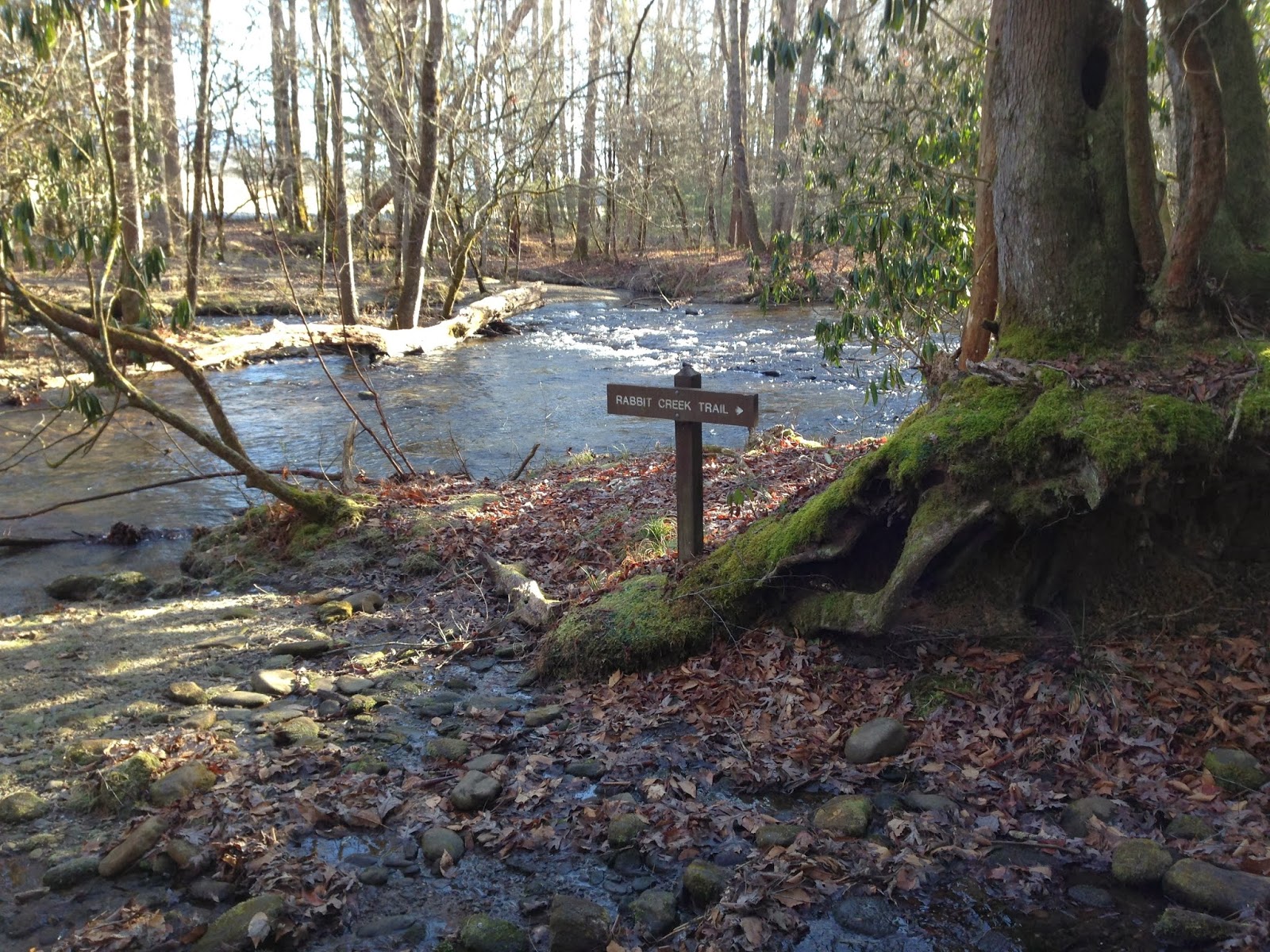
Rabbit Creek trailhead

The Rabbit Creek trail goes between Abrams Creek Ranger Station and Cades Cove.  Hannah Mountain trail goes from Parson Branch road up to Abrams Creek.  Today I did pieces of each, but didn't finish up either of them.

I started early this morning in Cades Cove where the Rabbit Creek trail shares a trailhead with the Abrams Falls trail.  The parking lot was nearly empty when I arrived.  One of the fun things about the Rabbit Creek trail is that it starts off going through Mill Creek.  Not over or around, but through…

crossing of Mill Creek at the beginning of the Rabbit Creek trail

I knew this ahead of time, and was prepared to take off my boots and wade, but then I spied a fallen tree that spanned most of the creek.  With my trekking poles in hand I headed across the fallen tree, hopeful that I'd avoid cold, wet feet.  Sadly, the creek got deeper and my trekking poles didn't reach the bottom. The fallen log got slippery, and kerplunk - I ended up knee-deep in Mill Creek.  I climbed out with nothing hurt, but it was not an auspicious beginning to the day.

Turns out it really didn't matter.  My feet would have gotten wet anyway, as a lot of the Rabbit Creek trail leading up out of Cades Cove is more creek than trail.  Rabbit Creek trail climbs quickly out of Cades Cove to a series of ridges, starting with "Coon Butt" :-)  The trail traverses gently up and down these ridges for a while before ultimately dropping down, down, down toward Rabbit Creek.

the Rabbit Creek trail on the dry, piney Cades Cove side

As the trail drops down into the Rabbit Creek valley it passes Campsite #15.  This is a really nice, open campsite, just up the hill from Rabbit Creek.  It looks to have several reasonable tent sites and a nice campfire area.  Water is easily accessible from Rabbit Creek.

marker for campsite #15

Campsite #15 - campfire area

Directly downhill from the campsite is Rabbit Creek which must be forded / rock-hopped.  By this time my feet were sort of dry-ish after their run-in with Mill Creek and the water laden ascent up the ridges. So I wasn't anxious to get them soaking wet again.  There are a series of well-placed rocks across Rabbit Creek at the ford so one can MOSTLY get across dry.

ford at Rabbit Creek

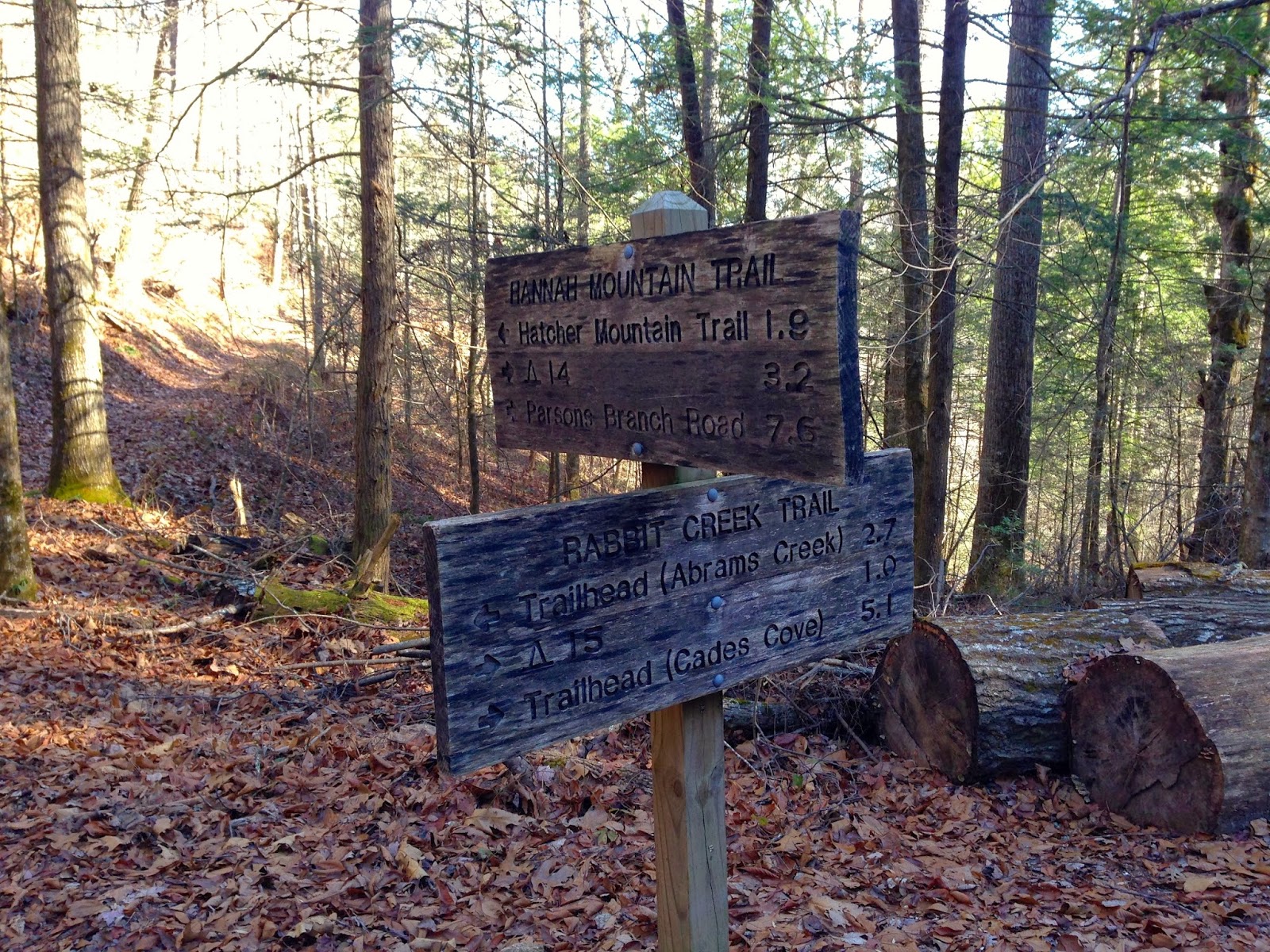
From here the trail ascends again for about a mile up to Scott Gap where the Rabbit Creek and Hannah Mountain trail intersect.  The Rabbit Creek trail continues on from Scott Gap toward Abrams Creek ranger station, but I turned north on the Hannah Mountain trail towards Abrams Creek.  It's about 1.9 miles from Scott Gap to the junction with Abrams Creek.

Rabbit Creek - Hannah Mountain trail junction

Also a few hundred yards below Scott Gap is Campsite #16. I walked down to the campsite, but I didn't see a whole lot to recommend.  It seems to be on a fairly sloped area and I did not see an obvious water source.

marker for campsite #16

campsite #16

Hannah Mountain trail from Scott Gap north is a pleasant walk through tulip poplar, hemlock and rhododendron.  There are a LOT of downed trees along this section, presumably from the tornado that blew through the area in 2011.  The trail descends gently for the first mile or so, and then begins to really drop on its way down to Abrams Creek.

pretty little waterfall along the Hannah Mountain trail


the final descent to Abrams Creek

I remember seeing this spot from the other side of Abrams Creek about four years ago.  We had camped at Campsite #17 and then hiked up to Abrams Falls, and I remember stopping at the spot where the southernmost section of the Hatcher Mountain trail meets Abrams Creek.  It was cool to see it from the other side of the creek today.

looking across Abrams Creek to Hatcher Mountain trail

I stopped here to soak in some sun, eat lunch and dry out my socks a little.  As I sat I *briefly* contemplated attempting to ford Abrams Creek so I could take the Abrams Falls trail back to Cades Cove.  It would have cut off about 3 miles of walking and would have made a nice loop, but the water was cold and deep in places, and I was alone.  Plus that was NOT the itinerary I had left behind, so if I got into trouble nobody would know where to look for me.  Someday I want to come back and make this ford, but probably in August or September, and certainly not alone.

From here I turned around and retraced my steps.  When I finally arrived back at the trailhead I didn't try the downed tree again.  I simply plunged straight through the creek at the ford.  The water was COLD, but it was quick.  

All in all it was an amazing day to be out in the Smokies.  The sky was blue, the temperature was cool, but sunny, and I really enjoyed hanging out on the banks of Abrams Creek.  Can't believe this is the first time I've checked off any new miles in the park since last June!  Still, I'm making slow and steady progress on completing all the trails in the park.  Looking forward to getting out there again.

Til next time, happy hiking!

Monday, June 10, 2013

Appalachian Trail: Newfound Gap to Davenport Gap

New Miles Completed: 31.4
Total Miles Hiked:  ~ 35
7-9 June 2013

Thirteen years ago I hiked the western portion of the Appalachian Trail through the Smokies, from Newfound Gap down to Fontana Dam.  It was the first big backpacking trip I did after we moved to Tennessee and I did it solo.  I was relatively ill-prepared and inexperienced then, and I'm sure I carried WAY too much in my pack, but it was a great trip nonetheless.  This past weekend I finally got to finish off the AT in the Smokies by doing the eastern section: from Newfound Gap to Davenport Gap.  This time I went with my hiking buddy Shane, and I was a lot better prepared and more experienced.  It was a fantastic trip!


trailhead at Newfound Gap

Shane's wife Sarah was kind enough to get up early and shuttle us up to Newfound Gap Friday morning.  It was drizzly, and the top of the mountains were socked in with fog.  I love the trail sign at Newfound Gap: "Katahdin Maine 1972.0"  I can imagine that's a little overwhelming to the AT thru-hikers who make it to this point.

In general the AT through the GSMNP follows the TN/NC border and the spine of the tallest mountains in the park.  Our starting point at Newfound Gap is over 5,000 ft in elevation and the bulk of the trail meanders up and down between 5,000 - 6,400 feet.

Day 1:  Newfound Gap to Pecks Corner shelter.  10.8 miles

The first day out we went nearly 11 miles.  Along the way we went up and over three peaks and passed both the Icewater Spring shelter and Charlies Bunion.

Icewater Spring shelter
 Icewater Spring shelter is only a couple of miles from Newfound Gap and sits on a fairly exposed ridge with outstanding views, so it's a very popular destination.  Sadly, when we arrived the mountain was still completely fogged in, so there were no views.  We did meet several hikers here, including a couple of long-distance hikers that we would see often over the next couple of days.  "Mush Mouth" and "Void" were friends from Kansas who are hiking from Springer Mountain, GA (the southern terminus of the AT) to Harpers Ferry, WV (sort of the midpoint of the AT).  We stopped in for a snack and to say hello.


Sand Myrtle in flower at Charlies Bunion
Charlies Bunion
The next major stop was Charlies Bunion, less than a mile down the trail from Icewater Spring.  This is a huge bare outcrop of slate with sheer drops on three sides, and (on clear days) amazing views down the valley.  It's a fun (but scary) place to visit and there are signs that warn parents to "closely control children."  The rock faces here were covered with Sand Myrtle in flower - this is a member of the Heath family that only grows on particular rock formations at high elevation in the Smokies.

I should point out that there are MANY trails that intersect the AT along its length in the GSMNP.  For the sake of brevity I will not mention or post pictures of all of the trail junctions like I usually do, but there are lots of ways to get up to the AT from the lower regions of the park.

Early in the afternoon I mentioned that I was getting hungry and that we should look for a place to stop for lunch.  Shane agreed, and not 2 minutes later we came around a corner of the trail to find a long block of rock at the edge of the trail with amazing views down into North Carolina.  The sun had come out and we basked as we ate and drank in the views.


view from the AT down into North Carolina
Our destination for the first night was Pecks Corner shelter which sits about 0.4 miles down the Hughes Ridge trail from the AT.


Pecks Corner shelter
Pecks Corner shelter is of the same general construction as all of the trail shelters in the park.  They are 3-sided stone structures with a two-level wooden bunk system, bench & table sets along the front for cooking, a fireplace, and cables to hang food bags away from the bears.  This particular shelter sits pretty far down a narrow valley.  There was an excellent spring and a composting privy on site.  In addition to Mush Mouth and Void we met up here with several other folks.  A mom and her two kids from San Diego, CA who are working on a thru-hike of sorts; Cobweb, a southbound thru-hiker who is finishing up his interrupted thru-hike from last year; and a section hiker from west Tennessee who teaches school in southern Illinois.  All in all it was a diverse and interesting group and we had lots of good conversation.  As is usual on the trail though, bed time comes early and we were all in our sleeping bags by about 8 pm.

Day 2: Pecks Corner shelter to Cosby Knob shelter. 13.3 miles


up and ready to hit the trail the morning of day 2 at Pecks Corner shelter
Our second day out the trail went up over (or around) the summit of some very high mountains: Mt. Sequoyah, Mt. Chapman, and Mt. Guyot, all over 6,000 feet in elevation.  From there the trail drops down toward Cosby Knob and Low Gap.  This section of the trail is one of the most remote in the park - you are many miles away from any road here.  It's also amazingly beautiful as you traverse the narrow spine of the mountains.  In many places the trail is not more than a few feet wide with sheer drops of hundreds or thousands of feet down on either side.  It's both eerie and exhilarating at the same time.  And the views...  Pictures simply can't do justice to the beauty.


early morning mist rising from a mountain valley
Along the way we stopped at the Tricorner Knob shelter for lunch.  This shelter is very close to the AT and sits in a nice open and sunny area.  The spring that is the shelter's water source is right next to the shelter and spreads out to form a very wet and muddy area directly in front of the shelter. 


Tricorner Knob shelter
After lunch and a rest we headed on down the trail.  Along the way we passed (and almost missed!) the wreckage of an Air Force F-4 jet plane that crashed here on January 4, 1984.  There's a good description and lots of pictures here.


piece of twisted metal from the plane wreck
We also met up at the Snake Den Ridge trail junction with a group of trail volunteers who were heading up the trail to do maintenance.  They were part of the S.W.E.A.T. Crew program and carried not only all the necessary camping equipment and food, but also all the tools and materials necessary for a week's worth of trail work.  Thanks a lot for everything you do!


rake and axe handles from the S.W.E.A.T. crew leaning against the trail sign

Late afternoon we made it in to the Cosby Knob shelter for the night.  Shane and I had stayed here with some of our Boy Scouts back in February when there was quite a bit of snow and temperatures in the single digits. 

Cosby Knob shelter
We met up again with some folks from the previous night, and also met some new ones, including a couple more thru-hikers.  Fun conversations again, and in bed around 9 pm.  There were a couple of really heavy-duty snorers though, that made sleeping tough.  It was definitely NOT the most restful night I've ever had on the trail, for sure, but I guess that's one of the prices of staying in a shelter.

Day 3:  Cosby Knob shelter to Davenport Gap and I-40.  11.2 miles

Sunday morning we actually covered 0.8 miles of trail that we had hiked back in February, from Cosby Knob shelter down to Low Gap.  And from Low Gap, back up fairly steeply to the ridge of Mt. Cammerer.  One of the things I was really looking forward to on this trip was a visit to the Mt. Cammerer fire lookout.  I'd seen pictures, but never had the chance to visit before.  It was a beautiful structure, on a beautiful site, with beautiful views!  Absolutely amazing!

Mt. Cammerer fire lookout
me at the Mt. Cammerer lookout
view from Mt. Cammerer lookout
The side trail from the AT out to the lookout is 0.6 miles each way, with its own ups and downs and rock scrambles.  But it was well worth the extra 1.2 miles!

From the top of Mt. Cammerer the AT drops rapidly from nearly 5,000 feet elevation down to about 2,000 feet at Davenport Gap over a distance of about 5 miles.  It was like dropping through time as well - plants that were still in bud up top were out in full flower the further down we got, and we started to see species that occur at lower elevations that we hadn't seen up high.  The temperature and humidity also seemed to increase steadily as we descended.

About a mile from Davenport Gap and the park boundary is a short side trail to the Davenport Gap shelter.  

Davenport Gap shelter
It sits in a picturesque little hollow, but was somehow a bit stifling.  It's one of the few (maybe the only?) trail shelters that still has a wire fence across the front to keep out the bears, and does not have bear cables to hang food bags from.  There's also no privy.  Not exactly sure why, but it just didn't strike me as someplace I'd like to spend an evening.  We stopped to eat a bite of lunch and fill our empty water bottles before heading out.  From here it was just a hop, skip and jump down to the park boundary at Davenport Gap.

Shane at the park boundary in Davenport Gap
While this finished up the AT through the GSMNP for us, we still had 1.9 miles of hiking on the AT to get to Interstate 40 and our pickup point.  From Davenport Gap the AT first winds through a dry piney forest, and then drops down into a cool hardwood & rhododendron forest with a lovely creek paralleling the trail.  The creek ultimately spills  into the Pigeon River and the AT crosses a bridge over the river and then under the I-40 overpass.  My son Jesse arrived to pick us up just about 5 minutes after we stepped out of the woods - perfect timing (especially good since my cell phone reception was pretty spotty around there).

AT marker at the trail entrance near I-40
What else can I say?  This was a trip that I've planned and dreamed about occasionally since 2000, and actively for about the last five years.  Shane is the best hiking partner I can imagine - we're well-suited to each other in a lot of ways, and always have a great time hiking and backpacking together.  The trail was tough - in places it is narrow and deeply rutted, it's often very rocky, and this weekend was very wet (my boots didn't fully dry the whole time we were out).  But the beauty of the views, the excitement of walking the narrow ridges, the gorgeous wildflowers, and cool side trips all combined to make this one of the best backpacking trips ever.  I highly, highly recommend this trip to anyone who is prepared for the rigors and interested in the scenery.

I plan for this to NOT be my last backpacking trip this summer.  Definitely want to get a few more trails knocked out, so stay tuned for more.  

Til next time, happy hiking!